
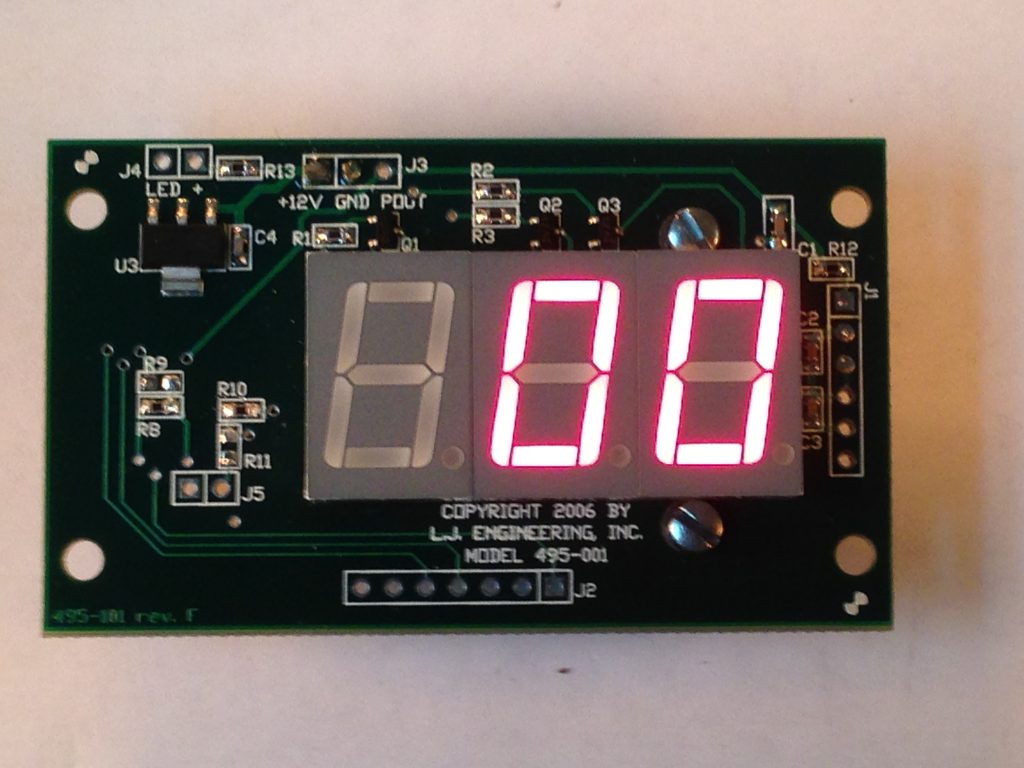
Various units of measure and several vacuum and pressure ranges are available. All gauges feature 0.56-inch red LED numbers readable from 20-feet away. All units have an accuracy of +/-0.25% of the full scale display reading.
Our digital vacuum gauges, digital pressure gauges, absolute pressure gauges and differential pressure gauges are for measuring vacuum and pressure of dry gases. Optional liquid/air separator filters are available for systems containing liquids.
DVG-2 pic
The gauge is enclosed in a splash-resistant, high-impact ABS plastic enclosure with mounting flanges for attachment.
A 120 VAC wall adapter power supply and 4 ft hose assembly with 1/8″ pipe fitting is included.
OEM gauges
OEM (Original Equipment Manufacturer) versions of the gauges are available for easy integration into an OEM product design or gauge display into a user’s control panel.
The OEM models require the user to provide a DC power source of 8 to 26 volts at 250ma (minimum supply current). (Installation instructions)
Type of Gauge information
Vacuum can be measured either as differential vacuum or absolute pressure. A Vacuum Gauge measures vacuum relative to the surrounding atmospheric pressure. Therefore, a zero reading occurs when no vacuum is applied to the gauge and the stronger the vacuum the greater the reading.
Absolute pressure references perfect vacuum as a zero pressure reading. When no vacuum is applied the gauge will indicate atmospheric pressure. As vacuum is increased the reading will decrease until perfect vacuum (zero absolute pressure) is reached, which will indicate zero. Therefore, an absolute pressure gauge at sea level will indicate approximately 29.92 inches of mercury, or 14.7 pounds per square inch, or 760 mm of mercury or 101 kPa or 1013 millibar. The absolute pressure scale is often used in scientific applications such as: measuring the boiling point of liquids under vacuum, also simulating a specific altitude by measuring the absolute pressure.
Differential Pressure Gauges measure the difference between two different pressure sources. For example it could be the pressure difference across a filter, valve or restrictor. Differential pressure gauges require that the proper pressure relationship is applied to the corresponding port. In other words the high-pressure port must always be at a pressure equal to or greater than the pressure applied to the low-pressure port.
Please contact the factory for other pressure/vacuum ranges and units of measure or special options such as an analog output.
Each gauge is calibrated and tested when assembled. A certificate of conformance is furnished with each gauge. If a Calibration Certificate showing actual test values is needed a certificate can be furnished for a nominal charge.